
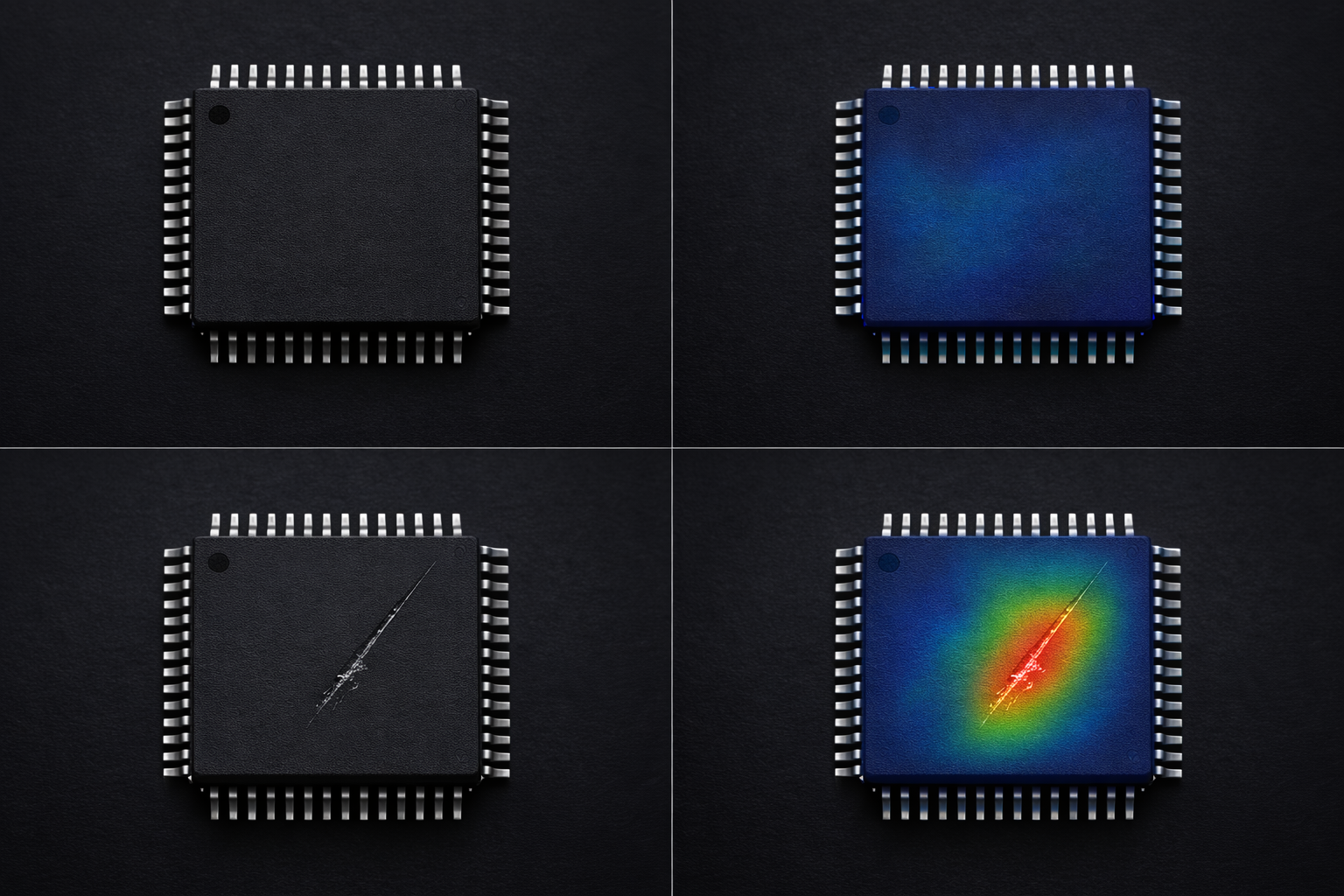
Anomaly detection is a fundamental problem in machine/deep learning and data analysis, aimed at identifying patterns that significantly deviate from expected or normal system behavior. Such anomalies often correspond to rare events, faults, security threats, or environmental changes and play a crucial role in ensuring the reliability, safety, and efficiency of modern technological systems.
Our laboratory focuses on the development of advanced machine learning and deep learning methodologies for detecting anomalies across heterogeneous data modalities, including visual data (images and video), radio-frequency signals, and other fields like WiFi.
Traditional anomaly detection techniques often rely on predefined rules or handcrafted features, which are insufficient for capturing the complex structures and various behaviors present in real-world data. To overcome these limitations, our research explores modern data-driven approaches including unsupervised and self-supervised learning, representation learning, and deep neural architectures capable of learning robust models of normality.
Our goal is to design scalable, adaptive, and interpretable anomaly detection systems that can operate effectively in real-time and in complex environments.
Potential topic:
– Visual Anomaly Detection
- Self-supervised and unsupervised learning approaches for visual anomaly detection
- Deep generative models (autoencoders, diffusion models, GANs) for modeling normal image distributions
- Detection of defects and irregularities in industrial inspection and quality control
- Robust anomaly detection under domain shifts, occlusions, and noisy data
- Explainable and interpretable models for understanding anomalous visual patterns
– Signal-Based Anomaly Detection
- Deep learning architectures for radio-frequency (RF) anomaly detection
- Spectrum monitoring and anomaly detection in wireless communication systems
- Machine/Deep learning methods for time-series anomaly detection
- Representation learning for complex signal patterns in dynamic environments
- WiFi-based sensing for human activity recognition and environmental monitoring
Involved Researchers
Valerio Pradisi